How to Create a Harry Potter-Inspired Home Office Library That Feels Grown-Up
There is a particular kind of room that seems made for long evenings, unfinished books, handwritten notes, and ideas that arrive after everyone else has gone to sleep.
Harry Potter introduced an entire generation to spaces like this: libraries filled with towering shelves, candlelit corridors, old desks, mysterious objects, astronomy rooms, worn books, and interiors that seemed to have collected centuries of stories.
Recreating that feeling at home does not require turning a room into a film set.
In fact, the most convincing Harry Potter-inspired study may contain almost no obvious franchise merchandise at all.
Instead, the room can borrow from the visual language behind the wizarding world: old academic buildings, English libraries, dark wood furniture, brass instruments, handwritten papers, botanical specimens, antique textiles, and lighting that creates small pools of atmosphere around the room.
The result is part home office, part personal library, and part retreat.
A room designed for work — but also for curiosity.
Begin with the Library, Not the Theme
The books should be the foundation of the room.
Rather than beginning with decorative memorabilia, start by deciding how the library will function.
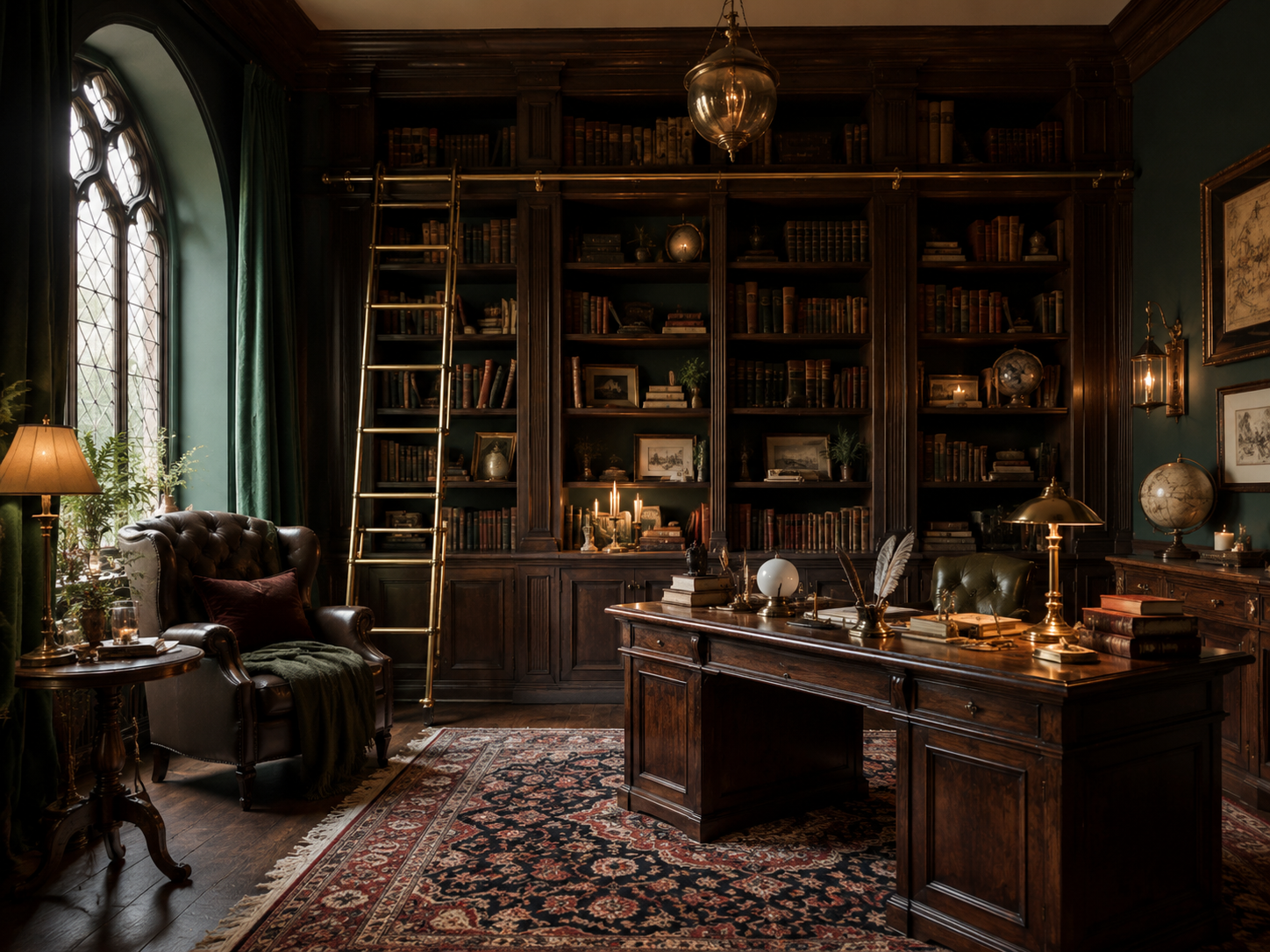
A wall of floor-to-ceiling shelving immediately creates the sense of a scholarly study, but smaller rooms can achieve the same effect with several bookcases placed closely together.
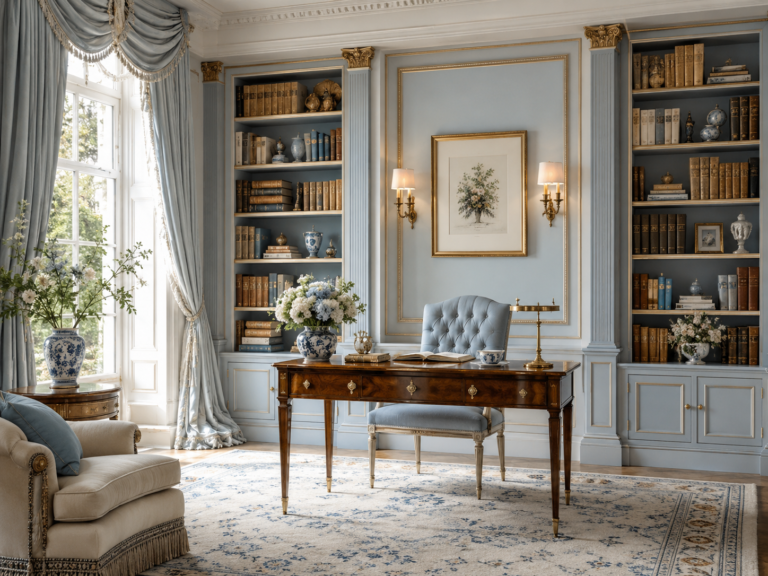
Dark walnut, mahogany, painted forest green, deep brown, or nearly black shelving will create more visual depth than bright white units.
Do not arrange every shelf too perfectly.
A library becomes more convincing when books vary in height and orientation. Some can stand upright, others can form small horizontal stacks. Leave occasional areas for objects, but allow books to remain the dominant feature.
A mixture of older hardcovers and newer books can work beautifully together.
If some modern covers feel too visually loud, group them by color or place them on lower shelves rather than hiding the entire collection behind decorative book jackets.
This should remain a real library.
The room becomes more interesting when it reflects what its owner actually reads.
Give the Desk a Sense of History
The desk should feel substantial enough to anchor the room.
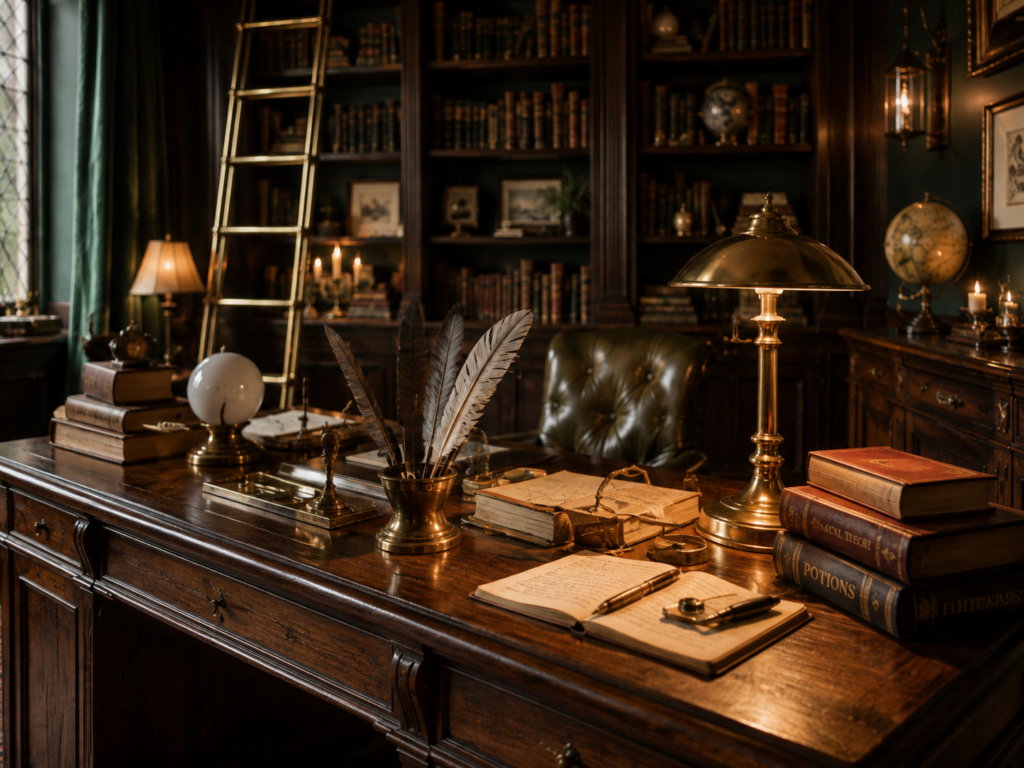
A dark wood writing desk is the most natural choice, particularly one with drawers, visible grain, or traditional joinery. It does not need to be antique, but it should avoid looking overly sleek or technological.
A modern computer can still belong here.
The trick is to surround contemporary technology with materials that soften it.
A leather or wool desk mat can create a darker working surface. A brass or bronze desk lamp adds a more architectural element. Wooden trays can organize notebooks, chargers, and small accessories.
Keep the center of the desk relatively clear.
Then add only a few objects that suggest study and curiosity:
- A fountain pen or writing set
- A small brass magnifying glass
- A notebook with a cloth or leather cover
- A wooden pencil cup
- A vintage-style letter tray
- A small clock
- One unusual object collected from travel or a flea market
The desk should look as though someone genuinely works there.
Not as though someone decorated it five minutes before taking a photograph.
Build the Room Around Deep, Scholarly Colors
This room should not rely on the pale neutral palette used throughout many contemporary interiors.
A Harry Potter-inspired office benefits from darker and more saturated colors.
Consider:
- Forest green
- Oxblood
- Deep plum
- Ink blue
- Tobacco brown
- Charcoal
- Burnished gold
- Dark walnut
You do not need to use all of them.
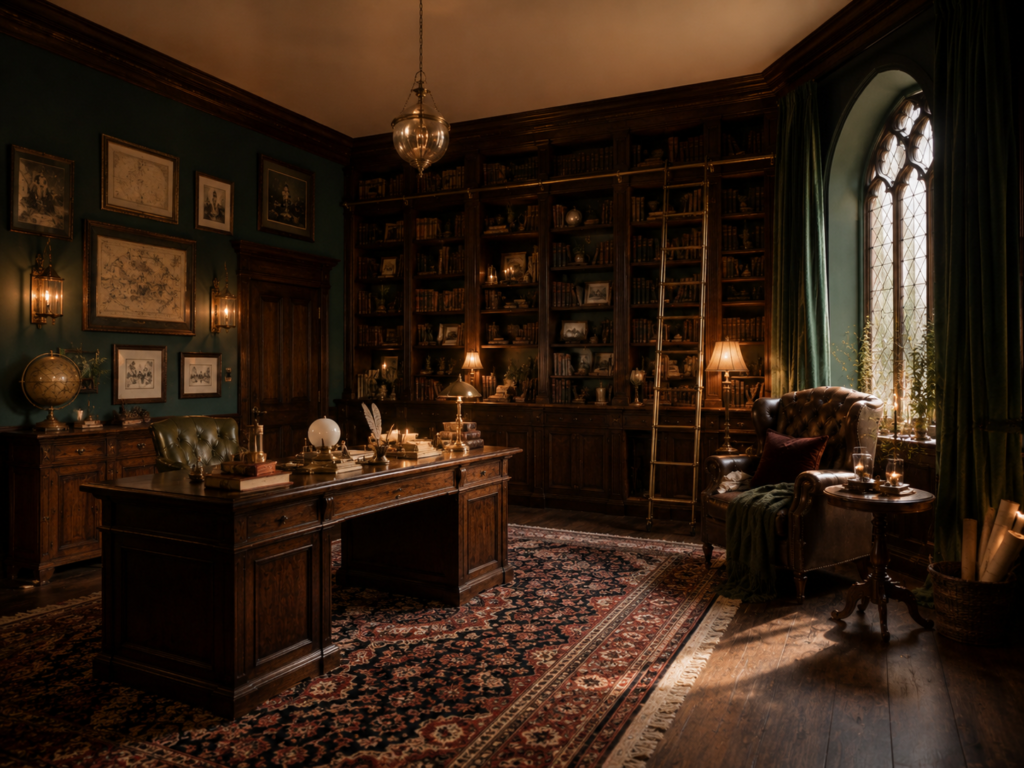
Choose one dominant color and allow the others to appear through books, rugs, upholstery, artwork, and accessories.
For example, forest green bookcases against a softly aged cream wall can create an old-library character without making the room excessively dark.
Another option is to paint the entire room a deep color, including shelving and trim, then introduce lighter parchment, linen, and brass details for contrast.
This is where the concept can become more personal.
Instead of directly reproducing the colors of a particular Hogwarts house, use those palettes only as loose inspiration.
Deep green does not need a crest beside it.
Burgundy does not need a banner.
Subtlety will make the room more convincing.
Replace One Bright Ceiling Light with Layers
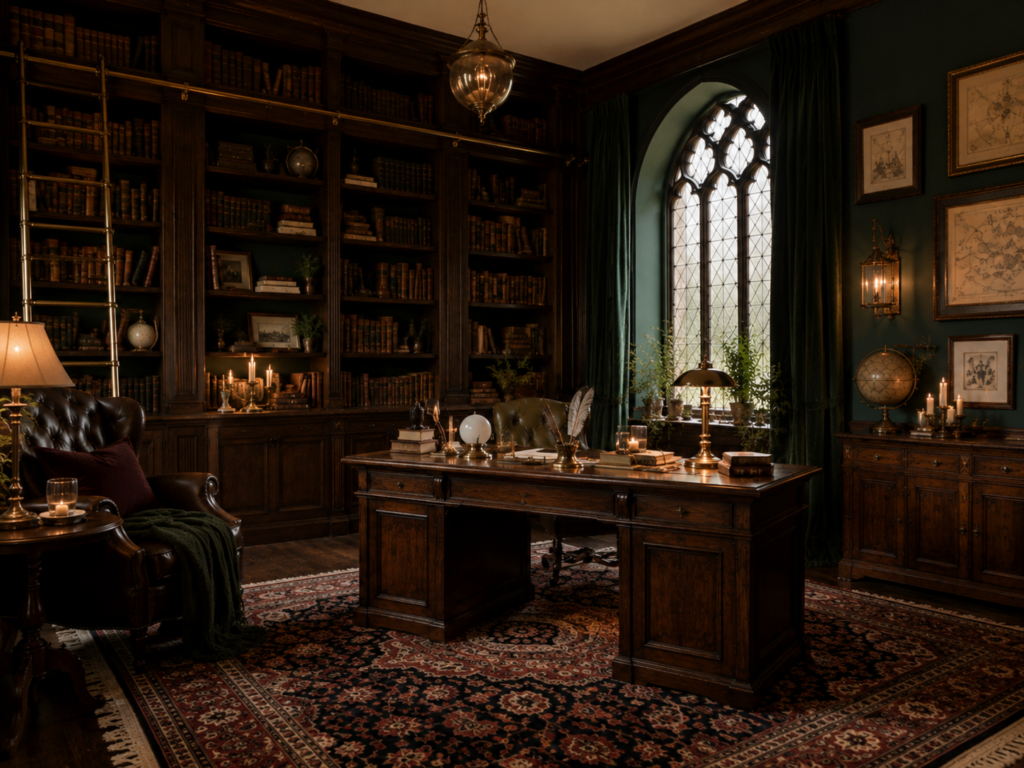
This concept depends heavily on lighting.
A single bright ceiling fixture can destroy the atmosphere immediately.
Instead, create several smaller sources of light.
A desk lamp should illuminate the primary working area.
A reading lamp can sit beside an armchair.
Wall sconces or picture lights can add illumination around the shelving.
A small lamp placed directly on a bookshelf can make the library feel especially intimate in the evening.
Warm-colored bulbs work well here, but the office still needs enough practical light for reading and computer work.
Think about lighting in layers:
Work light for the desk.
Reading light near the chair.
Ambient light around the shelves.
Accent light for art or architectural details.
This allows the room to change after sunset.
During the day it functions as an office.
At night it becomes something closer to a private library.
Create a Reading Corner That Feels Separate from Work
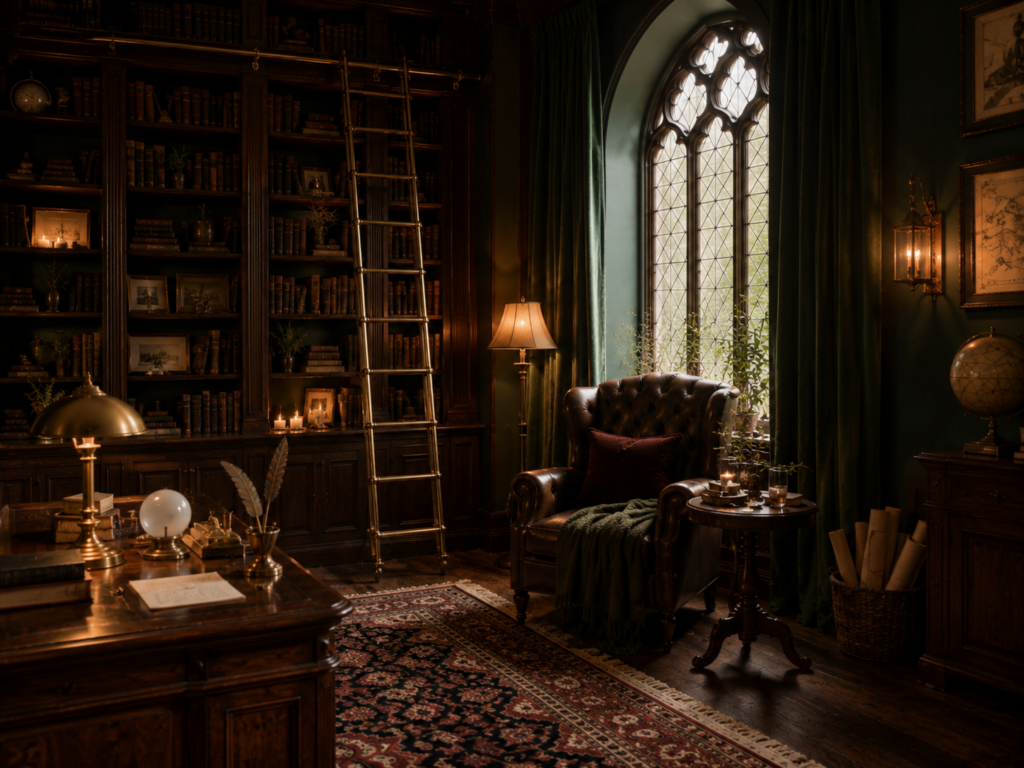
The library should offer somewhere to read that is not the desk chair.
Even a small room can usually accommodate one compact armchair.
Look for upholstery with texture and depth rather than something overly formal.
Leather can work beautifully, but so can olive velvet, burgundy wool, brown linen, or a traditional patterned fabric.
Place a small side table nearby.
It needs only enough surface for:
- A book
- A cup
- Reading glasses
- A small lamp
A footstool makes the corner more comfortable if space allows.
This is also a natural place for a heavier throw blanket or cushion in a richer pattern.
The goal is to create a visual distinction between work and reading.
One side of the room asks you to concentrate.
The other asks you to stay a little longer.
Let Astronomy Become the Magical Detail
One of the easiest ways to suggest the Harry Potter world without using obvious merchandise is through astronomy.
The subject naturally belongs in a scholarly library and introduces a slightly mysterious character.
Consider an old-style celestial map, moon-phase illustration, brass armillary sphere, vintage telescope, framed constellation chart, or small globe.
One or two pieces are enough.
Avoid filling every shelf with stars and moons.
The most effective themed interiors rarely repeat the same motif continuously.
An astronomy print above the desk may be all the room needs.
Paired with old books and a brass lamp, the reference becomes recognizable without becoming theatrical.
Add Curiosity Through Objects That Look Collected
A magical study should contain objects that make the viewer wonder where they came from.
This is where flea-market pieces, inherited objects, vintage shops, and travel finds can become more valuable than conventional decor.
Look for items such as:
- Old wooden boxes
- Brass candlesticks
- Small framed botanical illustrations
- Vintage binoculars
- Stone or ceramic vessels
- Antique-style scissors
- Old maps
- Magnifying glasses
- Specimen drawers
- Handmade pottery
- Small sculptures
- Weathered bookends
These objects should not all be displayed at once.
Distribute them through the shelving and allow some areas to contain books only.
A collected room needs empty space too.
Otherwise curiosity quickly becomes clutter.
Use Apothecary References Carefully
Glass bottles and apothecary jars can be an enjoyable reference to potions, but this is also one of the easiest details to overdo.
Avoid rows of artificially aged bottles covered in fantasy labels.
Instead, use a few real functional containers.
A glass jar might hold fountain pen cartridges.
A ceramic container could store pencils.
A small amber bottle can contain plant cuttings.
A dark glass vessel can simply sit beside a stack of books.
This approach gives the room the suggestion of an old laboratory without turning the office into a prop display.
The magic should be discovered gradually.
Bring in the Feeling of an Old School Through Textiles
Hard surfaces dominate libraries: wood, paper, glass, metal.
Textiles prevent the room from feeling severe.
A traditional rug is one of the strongest additions.
Persian-inspired patterns, faded reds, deep blues, olive greens, and muted gold can make even a newly built room feel more established.
Curtains can also change the architecture of the space.
Instead of short modern window coverings, consider curtains that extend closer to the ceiling and fall almost to the floor.
Heavy linen, wool blends, velvet, or textured cotton can all work depending on the amount of natural light.
The goal is not historical accuracy.
It is visual weight.
The room should feel protected from the rest of the house.
Hide Modern Office Clutter
One challenge with this concept is that real offices contain very unmagical objects.
Routers.
Charging bricks.
Extension cords.
Printers.
Plastic stationery.
Headphones.
External drives.
Do not pretend these objects do not exist.
Design storage for them.
Use desk drawers for cables and adapters.
Place the printer inside a lower cabinet when ventilation allows.
Run cables along the back of furniture.
Keep technology accessible but visually quiet.
A wooden box can contain charging accessories.
A cabinet can hold printer paper and office supplies.
The room works best when technology remains available without becoming its visual identity.
The computer is allowed to be modern.
Everything around it can tell a different story.
Make the Walls Feel Like Part of the Library
Bare walls can make an otherwise convincing library feel unfinished.
Artwork should continue the scholarly atmosphere.
Instead of generic motivational office prints, consider:
- Botanical studies
- Landscapes
- Old maps
- Architecture drawings
- Astronomy charts
- Engravings
- Vintage portraits
- Museum-style reproductions
- Framed handwritten pages or correspondence
Frames do not need to match perfectly.
Dark wood, antique brass, black, and aged gold can be combined if their proportions feel balanced.
A small gallery arrangement can work particularly well beside the bookshelves.
One oversized piece above the desk is another option.
Again, resist the urge to explain the theme.
A framed Hogwarts logo tells the viewer what the room is supposed to be.
A mysterious old astronomical drawing allows them to feel it.
Give the Room One Unexpected Detail
The best concept rooms contain one element people remember.
This could be:
A rolling library ladder.
A hidden cabinet disguised within the shelving.
A ceiling painted a very dark blue.
A vintage telescope positioned by the window.
An antique writing desk found secondhand.
A tiny reading nook built between two bookcases.
A stained-glass-style lamp.
A wall completely covered with books.
Choose one.
When everything in the room competes to be magical, nothing feels particularly magical.
One remarkable detail surrounded by quieter decisions creates a much stronger result.
Keep the Harry Potter References Subtle
There is nothing wrong with owning Harry Potter memorabilia.
A favorite illustrated edition, collectible object, or framed piece can absolutely belong in the room.
But it should be treated as part of a larger collection rather than the foundation of the design.
A few recognizable references can make the space personal.
Covering the room in logos, house crests, character imagery, and replicas can quickly shift the atmosphere from home library to merchandise display.
For a more grown-up interpretation, follow a simple rule:
Build the room first. Add the fandom second.
If the room still feels magical after all recognizable Harry Potter objects are removed, the design has succeeded.
A Study Made for Curiosity
A Harry Potter-inspired home office library does not need moving staircases, floating candles, or a collection of film replicas.
Its magic can come from something quieter.
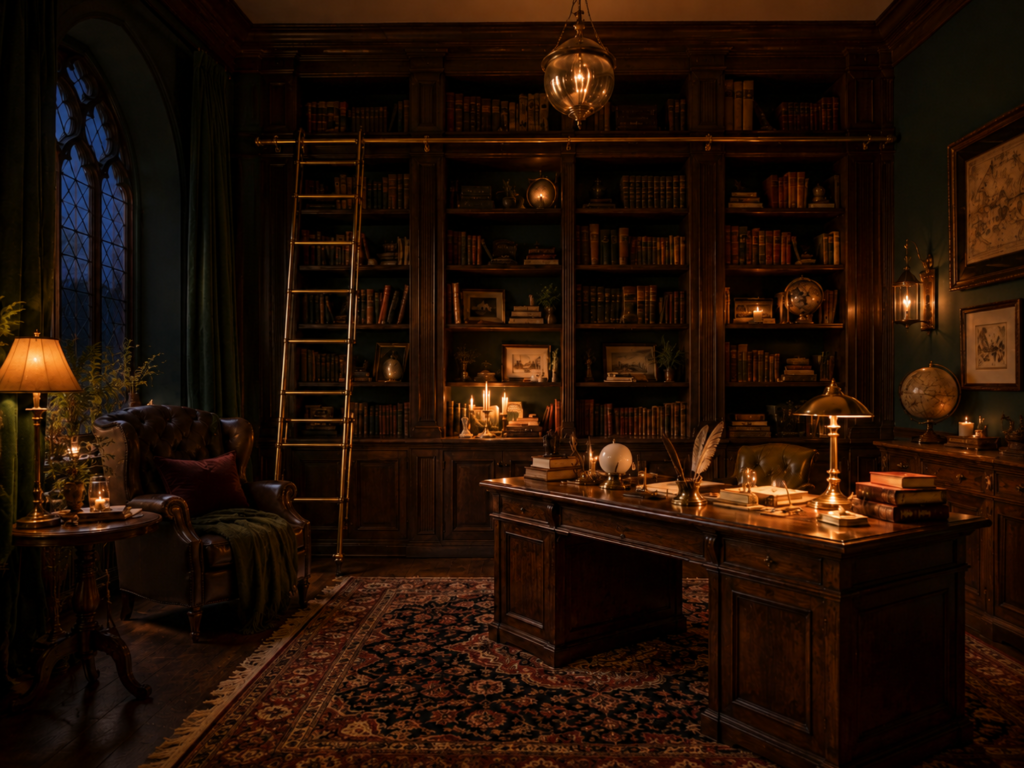
A wall full of books.
The pool of light from a brass lamp.
A worn rug beneath a wooden desk.
An astronomical drawing found above a shelf.
A chair waiting beside a stack of unfinished novels.
The strongest references to the wizarding world were never only magical objects.
They were places dedicated to learning, curiosity, discovery, and stories.
Build the room around those ideas and it can feel imaginative without becoming childish, nostalgic without becoming a replica, and distinctive without sacrificing its real purpose.
It becomes somewhere worth working in.
And perhaps, occasionally, somewhere worth disappearing into.